
Exploration 02
Exploration 2. Iris의 세 가지 품종 분류해볼 수 있겠어요?
1. Iris의 세 가지 품종, 분류해 볼까요?
붓꽃 분류 문제

2. 데이터 다루기
0. Iris plants 데이터 셋 확인
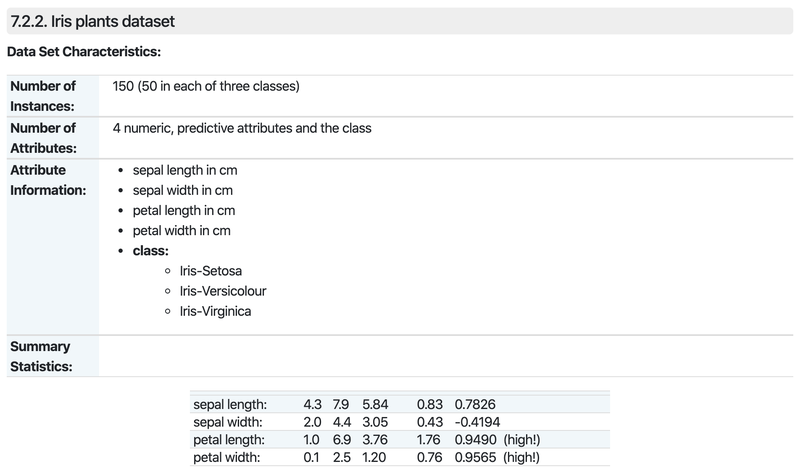
목표 → 꽃잎, 꽃받침의 길이와 폭 정보를 입력했을 때 붓꽃의 품종을 출력
1. 데이터 준비
from sklearn.datasets import load_iris

iris = load_iris()

print(dir(iris)) # dir()는 객체가 어떤 변수와 메서드를 가지고 있는지 나열함
# >>> ['DESCR', 'data', 'data_module', 'feature_names', 'filename', 'frame', 'target', 'target_names']

iris.key() # iris에 담긴 정보 확인
# >>> dict_keys(['data', 'target', 'frame', 'target_names', 'DESCR', 'feature_names', 'filename', 'data_module'])

iris_data = iris.data # iris객체를 변수에 저장 후 크기정보 출력
print(iris_data.shape)
# >>> (150, 4)

iris_data[0] # 샘플데이터 확인
# >>> array([5.1, 3.5, 1.4, 0.2]) 왼쪽부터(sepal length, sepal width, petal length, petal width)
iris_label = iris.target # target(label) 확인 (머신러닝이 출력해야 하는 정답)
iris.target_names # label 이름 확인
print(iris.DESCR) # iris의 나머지 변수들 확인pandas로 데이터 다루기
# 데이터프레임에 iris데이터 넣고 컬럼에는 frature_names(sepal length, sepal width, petal length, petal width)넣기
iris_df = pd.DataFrame(data=iris_data, columns=iris.feature_names)
# 정답 라벨 컬럼 추가
iris_df["label"] = iris.target
문제지 : 머신러닝 모델에게 입력되는 데이터 (feature)
정답지 : 머신러닝 모델이 맞혀야 하는 데이터 (label, target)
training dataset, test dataset 준비
사이킷 런의 train_test_split()을 이용해 150개의 데이터셋을 train 120, test 30으로 나누기
from sklearn.model_selection import train_test_split

X_train, X_test, y_train, y_test = train_test_split(iris_data,
                                                    iris_label,
                                                    test_size=0.2,
                                                    random_state=7)

print('X_train 개수: ', len(X_train),', X_test 개수: ', len(X_test))
'''
>>> X_train 개수:  120 , X_test 개수:  30
'''
train. test set 확인
X_train.shape, y_train.shape
X_test.shape, y_test.shape

y_train, y_test
머신러닝은 크게 지도학습, 비지도 학습으로 나눠진다.
지도학습은 정답이 있는 문제에 대해 학습하는 것, 비지도 학습은 정답이 없는 문제를 학습하는 것
지도학습은 분류, 회귀로 나눠진다.
분류는 특정 카테고리 중 하나로 분류하는 문제이고, 회귀는 입력받은 데이터에 따라 특정 필드의 수치를 맞히는 문제이다.
2. 데이터 학습 시키기
Decision Tree model
Decision Tree는 직관적이면서도 간단하게 사용할 수 있어 분류 문제를 풀 때 가장 기본적으로 쓰이는 모델
단점 → 결정경계가 데이터 축에 수직이어서 특정 데이터에만 잘 작동할 수 있다는 문제가 있다. 이를 극복하기 위해 제안된 모델이 Random Forest이며, 여러 개의 Decision Tree를 합쳐서 만들어놓은 개념이다.
# 사이킷 런의 DecisionTreeClassifier이라는 모델 불러와 변수에 저장하기
from sklearn.tree import DecisionTreeClassifier

decision_tree = DecisionTreeClassifier(random_state=32)
모델 학습
decision_tree.fit(X_train, y_train)💡 새로운 데이터에 대해서도 잘 맞추기 위해서는 training set이 어떻게 구성되어 있는지가 매우 중요 **더 일반화된 데이터로 학습**이 될수록 새로운 데이터에 대해서도 잘 맞출 수 있다.
3. 모델 평가하기
y_pred = decision_tree.predict(X_test) # test셋을 입력으로 넣어 예측 후 변수의 저장정확도 계산
from sklearn.metrics import accuracy_score

accuracy = accuracy_score(y_test, y_pred)
"""
>>> 0.9
"""
4. 정리
# (1) 필요한 모듈 import
from sklearn.datasets import load_iris
from sklearn.model_selection import train_test_split
from sklearn.tree import DecisionTreeClassifier
from sklearn.metrics import classification_report

# (2) 데이터 준비
iris = load_iris()
iris_data = iris.data
iris_label = iris.target

# (3) train, test 데이터 분리
X_train, X_test, y_train, y_test = train_test_split(iris_data,
                                                    iris_label,
                                                    test_size=0.2,
                                                    random_state=7)

# (4) 모델 학습 및 예측
decision_tree = DecisionTreeClassifier(random_state=32)
decision_tree.fit(X_train, y_train)
y_pred = decision_tree.predict(X_test)

print(classification_report(y_test, y_pred))
"""
>>>
                precision    recall  f1-score   support

           0       1.00      1.00      1.00         7
           1       0.91      0.83      0.87        12
           2       0.83      0.91      0.87        11

    accuracy                           0.90        30
   macro avg       0.91      0.91      0.91        30
weighted avg       0.90      0.90      0.90        30
"""
3. 다른 모델들로 학습하기
1. Random Forest Model 학습
Random Forest Model
Random Foreat 모델은 Decision Tree 모델을 여러 개 합쳐놓아 Decision Tree의 단점을 극복한 모델이다. 이러한 기법을 앙상블 기법(단일 모델을 여러 개 사용하는 방법)이라고 한다.
Random Forest는 각각의 의사 결정 트리를 만드는데 있어 쓰이는 요소들을 무작위적으로 선정
from sklearn.ensemble import RandomForestClassifier

X_train, X_test, y_train, y_test = train_test_split(iris_data,
                                                    iris_label,
                                                    test_size=0.2,
                                                    random_state=21)

random_forest = RandomForestClassifier(random_state=32)
random_forest.fit(X_train, y_train)
y_pred = random_forest.predict(X_test)

print(classification_report(y_test, y_pred))
"""
>>>
                precision    recall  f1-score   support

           0       1.00      1.00      1.00        11
           1       1.00      0.83      0.91        12
           2       0.78      1.00      0.88         7

    accuracy                           0.93        30
   macro avg       0.93      0.94      0.93        30
weighted avg       0.95      0.93      0.93        30
"""
2. Support Vector Machine (SVM)
Support Vector Machine (SVM)
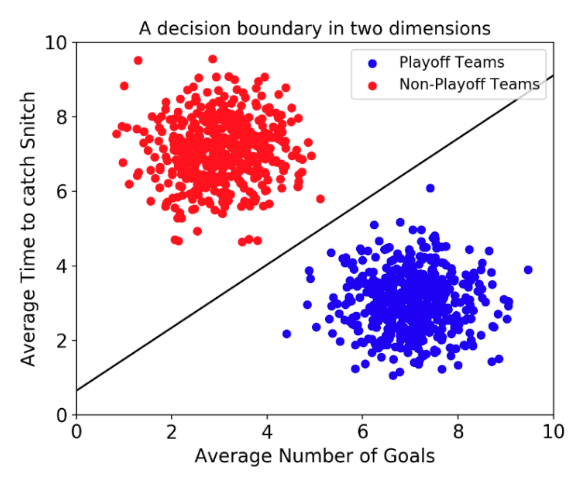
SVM은 Support Vector와 Hyperplane(초평면)을 이용해 분류를 수핼하게 되는 대표적인 선형분류 모델Decision Boundary(결정 경계): 두 개의 클래스를 구분해 주는 선
Support Vector: Decision Boundary에 가까이 있는 데이터
Margin: Decision Boundary와 Support Vector 사이의 거리
from sklearn import svm
svm_model = svm.SVC()

svm_model.fit(X_train, y_train)
y_pred = svm_model.predict(X_test)

print(classification_report(y_test, y_pred))
"""
>>>
                precision    recall  f1-score   support

           0       1.00      1.00      1.00        11
           1       0.91      0.83      0.87        12
           2       0.75      0.86      0.80         7

    accuracy                           0.90        30
   macro avg       0.89      0.90      0.89        30
weighted avg       0.91      0.90      0.90        30
"""
3. Stochastic Gradient Descent Classifier (SGDClassifier)
Stochastic Gradient Descent Classifier (SGDClassifier)
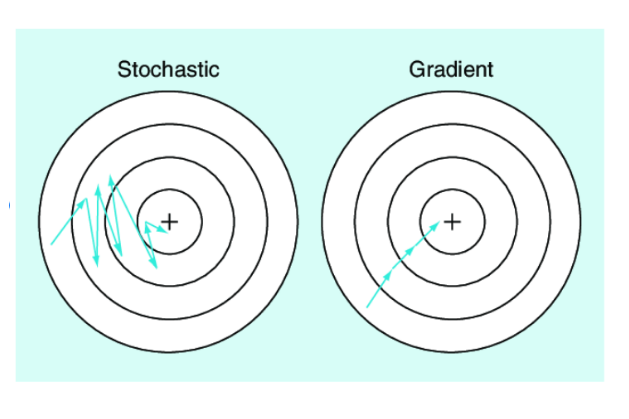
SGD는 배치 크기가 1인 경사하강법 알고리즘이다.
확률적 경사하강법은 데이터 세트에서 무작위로 균일하게 선태한 하나의 례흫 의존하여 각 단계의 예측 경사를 계산합니다.
단점 → 반복이 충분하면 SGD가 효과는 있지만 노이즈가 매우 심하다. 확률적 경사하강법의 여러 변형 함수의 최저점에 가까운 점을 찾을 가능성이 높지만 항상 보장되지는 않는다. (최저점을 찾지 못할 수 있음)
단점 극복 →미니 배치 확률적 경사하강법(미니 배치 SGD)사용
from sklearn.linear_model import SGDClassifier
sgd_model = SGDClassifier()

sgd_model.fit(X_train, y_train)
y_pred = sgd_model.predict(X_test)

print(classification_report(y_test, y_pred))
"""
>>>
                precision    recall  f1-score   support

           0       1.00      1.00      1.00        11
           1       1.00      0.83      0.91        12
           2       0.78      1.00      0.88         7

    accuracy                           0.93        30
   macro avg       0.93      0.94      0.93        30
weighted avg       0.95      0.93      0.93        30
"""
4. Logistic Regression
Logistic Regression
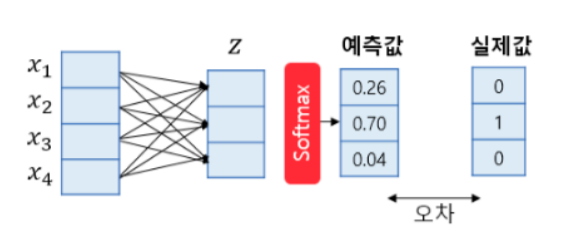
Logistic Regression은 가장 널리 알려진 선형 분류 알고리즘이다.
소프트맥스 함수를 사용한 다중 클래스 분류 알고리즘이다.
이름은 회귀지만 실제로는 분류를 수행
from sklearn.linear_model import LogisticRegression
logistic_model = LogisticRegression()

logistic_model.fit(X_train, y_train)
y_pred = logistic_model.predict(X_test)

print(classification_report(y_test, y_pred))
"""
>>>
                precision    recall  f1-score   support

           0       1.00      1.00      1.00        11
           1       1.00      0.83      0.91        12
           2       0.78      1.00      0.88         7

    accuracy                           0.93        30
   macro avg       0.93      0.94      0.93        30
weighted avg       0.95      0.93      0.93        30
"""
4. 불균형한 데이터의 정확도
손글씨 데이터를 불러와 학습실행
기존 라벨을 다 찾는것이 아니라 3만 맞히는 라벨 작성
# 코드를 입력하세요
from sklearn.metrics import accuracy_score
from sklearn.model_selection import train_test_split
from sklearn.tree import DecisionTreeClassifier

X_train, X_test, y_train, y_test = train_test_split(digits_data,
                                                    new_label,
                                                    test_size=0.2,
                                                    random_state=15)

decision_tree = DecisionTreeClassifier(random_state=15)
decision_tree.fit(X_train, y_train)
y_pred = decision_tree.predict(X_test)

accuracy = accuracy_score(y_test, y_pred)
accuracy
"""
>>> 0.9388888888888889
"""
모두 0인 라벨을 넣어서 정확도 측정
fake_pred = [0] * len(y_pred)

accuracy = accuracy_score(y_test, fake_pred)
accuracy
"""
>>> 0.925
"""
💡 불균형 데이터를 다룰 때 정확도는 정답의 분포에 따라 모델의 서을을 잘 평가하지 못하는 척도가될 수 있다.
오차 행렬
💡 오차행렬이란? → 정답과 오답을 구분하여표현하는 방법

프로젝트
https://github.com/Rogan-J/Aiffel_project/blob/main/Exploration/project/Exploration02.ipynb
'AIFFEL > exploration' 카테고리의 다른 글
| Exploration 06 (0) | 2022.01.20 |
|---|---|
| Exploration 05 (0) | 2022.01.18 |
| Exploration 04 (0) | 2022.01.13 |
| Exploration 03 (0) | 2022.01.11 |
| Exploration 01 (0) | 2022.01.04 |